
Naming the Jew
Antisemitism is exploding on the right, and even Jews—and the people who are paid big bucks to represent them—don’t know how to define it

I want to offer apologies for my long absence. The truth of the matter is, I had a lot to say about the state of America, but I didn’t know where to begin.
It might sound strange, but I feel much better about things now, even as it’s gotten so much worse out there. The last few years have been enlightening in a way only profound disappointment can be; of course, the story would be a lot sexier if it would include repudiation of beliefs or people, but it doesn’t.
What’s happening now in America really isn’t the result of decades-old policy decisions, the cost of living, or faulty (or even evil) political philosophy. It was made possible only by technology: a deliberate campaign of political demoralization, encouraging the proliferation of conspiracy theories and a self-radicalizing ghetto of group chats and social media bubbles, all goosed by hostile foreign actors and algorithms.
For the last several years, I knew that the the infotainment media ecosystem that controls the id of the Right and, to a large extent, the GOP, would lead it to some very dark places—and we’re here now.
And, for the first time in history, we are being led by politicians who are inside the echo chamber with us, just as captive to hostile information war narratives. On some issues, they’ve allowed themselves to outsource their brains to podcast bros and the algorithmic zeitgeist. Many of these people are quite bright, and even decent people—but they were a lot smarter and tied to reality even a year ago. I’ve taken to calling it, “Rapid-Onset Elite Right-Wing Social Media Retardation.”
I’ll have a lot more to say about all these things soon. Until then, here is a piece I wrote recently for Tablet.
Naming the Jew
Antisemitism is exploding on the right, and even Jews—and the people who are paid big bucks to represent them—don’t know how to define it
LAS VEGAS—The Republican Jewish Coalition’s 40th Anniversary Leadership Summit at The Venetian Resort in Las Vegas last weekend should have been a confident celebration. As Donald Trump, the most pro-Israel president in the nation’s history, addressed the attendees by video from the White House, his administration wages legal and regulatory war on colleges and universities that failed to protect Jewish students and faculty from antisemitic mobs on campuses. In Israel, Hamas’ living hostages have been returned to their families, and the IDF and the Mossad have either neutralized or substantially degraded enemies in Lebanon, Syria, Iran, and Yemen. A 12-day war over the skies of Iran saw the first real joint American-Israeli mission and an unprecedented level of military cooperation. Despite all that, however, the event—and the whole organization—seemed unsuited for this unique and uncomfortable moment for American Jews.
For four decades, the RJC has served as the GOP’s institutional bridge to Jewish donors and pro-Israel voters. It was built in the last years of the Cold War to push back against “Blame America” Democrats of 1984 and the external threats they exacerbated or ignored. About 500 attendees, mostly Boomers and dedicated Fox News loyalists, filled the ballroom. They cheered every mention of Donald Trump and booed for Zohran Mamdani.
But nearly every speaker this year—politicians, media figures, and social media influencers—mentioned the growing antisemitism on the right. Some in the audience seemed to understand who was being discussed, likely from group chats or social media. Others didn’t. For most, their favorite cable news channel still defined the boundaries of political awareness. By the weekend’s end, though, the speeches began to blur. Every speaker condemned “hate” and promised vigilance against the rising antisemitism within their own political coalition, and the audience applauded. Rep. David Kustoff of Tennessee warned about “hateful people,” urging Republicans to “castigate and condemn hate.” Florida Sen. Rick Scott echoed him: “Our side cannot tolerate antisemitism. We cannot—and will not—put up with it in our party.” Even as these comments were well intentioned and sincere, their repetitive and declarative content indicated that, beyond a forceful condemnation, the speaker didn’t know what else to say about antisemitism at all.
One notable exception was Sen. Ted Cruz, who issued the most direct warning of the weekend. “I am very concerned by what I see as antisemitism rising on the right at a level that I don’t recognize,” he told the audience, describing it as “a poison” and “an existential crisis in our party and in our country.” Cruz spoke with the urgency of someone who has watched it spread in real time, especially among young conservatives seduced by conspiratorial online media. “Too many people are scared to confront it,” he said. “How many elected Republicans do you see standing up and calling this out? … I am committed to calling out this garbage. I am committed to fighting this garbage. And I am committed to going to young people and saying, ‘These are poisonous lies.’”
Cruz’s speech was unusually direct for a sitting Republican politician, most of whom preferred polite euphemism. He named the problem plainly and called for courage in confronting it. Radio host Mark Levin, too, delivered a sharp warning against the mainstreaming of antisemitism, praising Trump’s record while urging conservatives not to excuse hatred inside their own ranks. Together, they set a tone of urgency that many in the room seemed unprepared to meet.
The confusion on display wasn’t unique to the RJC; it reflects a broader failure of imagination across Jewish institutional life. For decades, antisemitism was something safely external: a pathology of the far left, the campus fringe, or hostile regimes abroad. What’s emerging now is different. The new antisemitism speaks the language of patriotism, faith, and anti-elitism; it arrives disguised as cultural critique. It’s a theory of how the world works. To an audience conditioned by cable news, it sounds insightful rather than bigoted. Inside the ballroom, there was no framework for understanding this shift. Politicians could condemn hate, but they couldn’t recognize it when it wore their party’s colors.
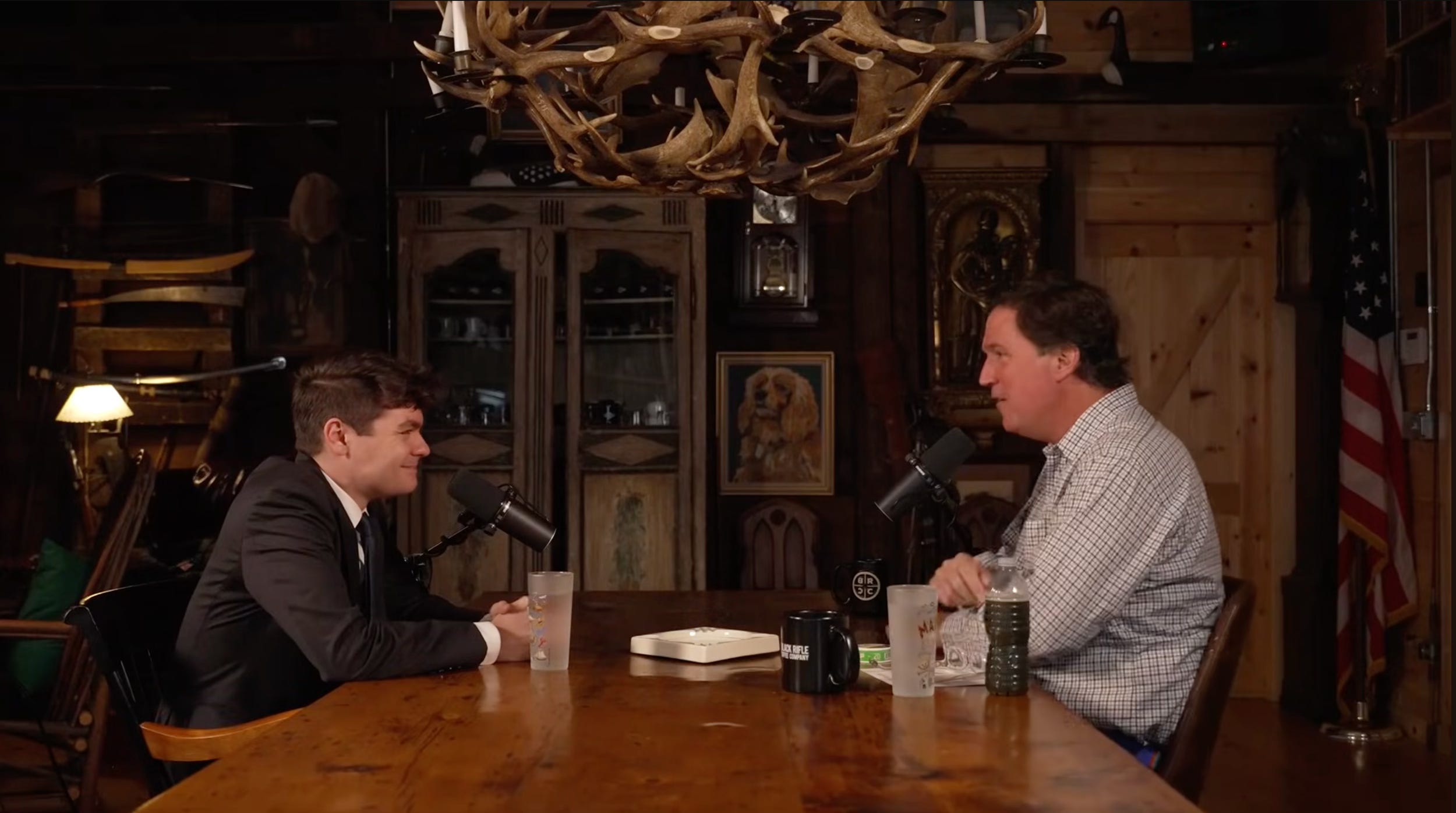
The reason this was bubbling up, of course, was Tucker Carlson. Not content with turning his media ventures into a parade of cranks, conspiracy theorists, and the self-radicalized, the former Fox host had just hosted the infamous 27-year-old, pro-Nazi streamer Nick Fuentes. “It was only a matter of time,” wrote Tablet’s Park MacDougald in The Scroll, describing Carlson’s show as “a parade of various Chinese intelligence assets, Code Pink activists, Obama operatives, pro-Trump-impeachment comedians, weepy Nazis, foreign priests, and ‘Jews-have-bugged-my-breakfast-cereal’ lunatics.”
Carlson has long preferred to launder his most controversial opinions through friendly interviews with guests who rarely reveal the extent of their own radicalism. The line Carlson crossed this time was to promote a guest who espouses explicit antisemitism; this was something new, even for him. Fuentes is blunt about his beliefs and has, over years, made tens of thousands of hours of content. He speaks openly of “organized Jewry” as a hostile force working to advance Jewish ethnic interests at America’s expense. He borrows from Kevin MacDonald’s The Culture of Critique, alternating between racial determinism and evolutionary sociology. Unlike Carlson—who so far has refrained from naming the culprits behind his recurring obsessions with finance, media, and foreign policy—Fuentes simply “names the Jew.”
Carlson, on the other hand, denies that his fixation with the supposed villainy of the Jewish state and its American defenders qualifies as anything like antisemitism but says it could be described more accurately as “criticism.” His anger at the accusation is palpable, as if he’s been unfairly slandered. He insists he has no particular animus toward Jews or Israel, pointing to many Jewish friends or fond family vacations to the Holy Land. It’s possible Carlson is even sincere; he might listen to RJC speeches about condemning “hate” and nod along, certain his heart is pure of malice.
Antisemitism, however, isn’t a state of being; it’s a pattern of behavior or speech. Abstract hatred (or love, for that matter) of anything without expression is irrelevant. And any definition of antisemitism that doesn’t capture Carlson’s conspiratorial worldview—his obsession with the machinations of Jews, his automatic belief in every story that casts them as corrupt, his fixation on Israel as the center of a global system of deceit—misses everything about antisemitism. It disarms Jews and others from understanding the ugliness they are clearly seeing and hearing, and it erases the historical context that makes this moment in America so perilous.
Carlson and Fuentes differ in tone and method. Carlson was the first prominent media figure to mainstream conspiracy material once confined to fringe broadcasters; today, he proliferates and mainstreams the latest accusations about Israel from the bowels of the internet. Fuentes rarely gets into those kinds of weeds, preferring humor and declarative statements for shock value. And, though openly antisemitic, Fuentes is far less contemptuous of Israel than the former cable host, often admiring its battlefield prowess and clowning on its enemies’ failures. In Carlson’s podcast universe, however, the guests he presents always wishcast the Jewish state on the verge of collapse and destruction.
For all their tonal differences, both Carlson and Fuentes converge on substance. Both describe a world secretly ruled by conniving Israeli puppet masters who, through disloyal American Jews and their heretical Christian Zionist allies, control U.S. foreign policy for their own ends through sexual blackmail, AIPAC payoffs, false-flag operations, and assassinations. Something of a pre-social-media meme, this worldview was once known in extremist shorthand as “ZOG,” or Zionist Occupied Government. The phrase surfaced in the 1970s and became a kind of dark joke among the paranoid, updating The Protocols of the Elders of Zion. It was the same story of omnipotent Jewish control, recast in contemporary America of the postwar era. While it has since incorporated thousands of new data points—the latest less plausible than the last—the conspiracy theory architecture hasn’t changed in a century.
By hosting Fuentes, Carlson offered his audience two flavors of antisemitism: explicit and denied. Fuentes names the Jew; Carlson insists he has nothing against Jews at all. But the coordinates are identical, and preferring one or the other is simply a matter of taste. They coexist comfortably because both point to the same destination. Antisemitism is not dangerous because it’s mean or offensive to the feelings or sensibilities of Jews; it is dangerous because it creates and circulates lethal fictions. It produces a weaponized alternate reality, one that leads inexorably to Jews being harmed or killed.
Carlson—not to mention Fuentes and countless others—argues nightly that this country is being controlled by nefarious Israelis. If that “hummus-eating” enemy is willing to commit a genocide in Gaza; deliberately manipulate American leaders into wars; assassinate critics; destroy churches; and oppress and slaughter Christians with impunity, then the problem is no longer political but civilizational. It becomes, in their telling, a battle against a uniquely devious and implacable foe—one that cannot be resolved by elections or arguments, but only by confrontation. The logic points beyond persuasion to elimination.
Fuentes is open about this. In declaring his admiration for Hitler, he merely follows his critique of “organized Jewry” to its natural conclusion. Carlson is far more careful and coy, but the trajectory is the same. His foray last year into World War II revisionism—an extended conversation with podcaster and revisionist historian of National Socialism Darryl Cooper—was not an eccentric detour but an attempt to rehabilitate Nazi Germany and its leader, largely by discrediting Churchill and the Allied cause. Even if these gestures are performative, the tens of millions who watch and listen are not in on the act.
What unites these audiences isn’t ideology so much as a way of seeing. In this world, nothing happens by accident; every war, election, or scandal confirms the existence of an unseen hand. The more elaborate the theory, the more convincing it feels. Carlson and Fuentes didn’t invent this pattern; they inherited and updated it into a modern vernacular of globalist plots, unipolar elites, and “foreign lobbies.” The content changes but the structure never does.
What Carlson and Fuentes broadcast isn’t “hate”; it’s a cognitive map built entirely on lies. Yet most people, including many Jews, still describe antisemitism as “anti-Jewish racism.” That mistake is fatal. Racism begins with emotion; antisemitism begins with explanation. Its logic is counterfeit, but it poses as reason all the same.
This confusion has deep roots. After the civil rights era, “hate” became the moral grammar through which all prejudice was understood. Jewish institutions, eager to speak that language, adopted it wholesale. Once antisemitism was redefined as an emotional or linguistic offense, its conspiracy core was buried under “tropes.” In that bucket, the falsehoods that launched pogroms and genocides—blood libel, world-Jewish control—were lumped together with trivial stereotypes.
The result was a flattening of meaning. Even the International Holocaust Remembrance Alliance’s official definition, adopted by governments and many Jewish groups, reflects this collapse. Its warning against “mendacious, dehumanizing, or demonizing allegations about Jews” treats antisemitism as a moral failure rather than an epistemic one.
The problem isn’t cruelty; it’s falsity, and the fact that for two millennia, people have acted on those lies.
—Originally published at Tablet.
Thanks for returning to substack. I am looking forward to more.
Glad your back, superb Tablet piece